

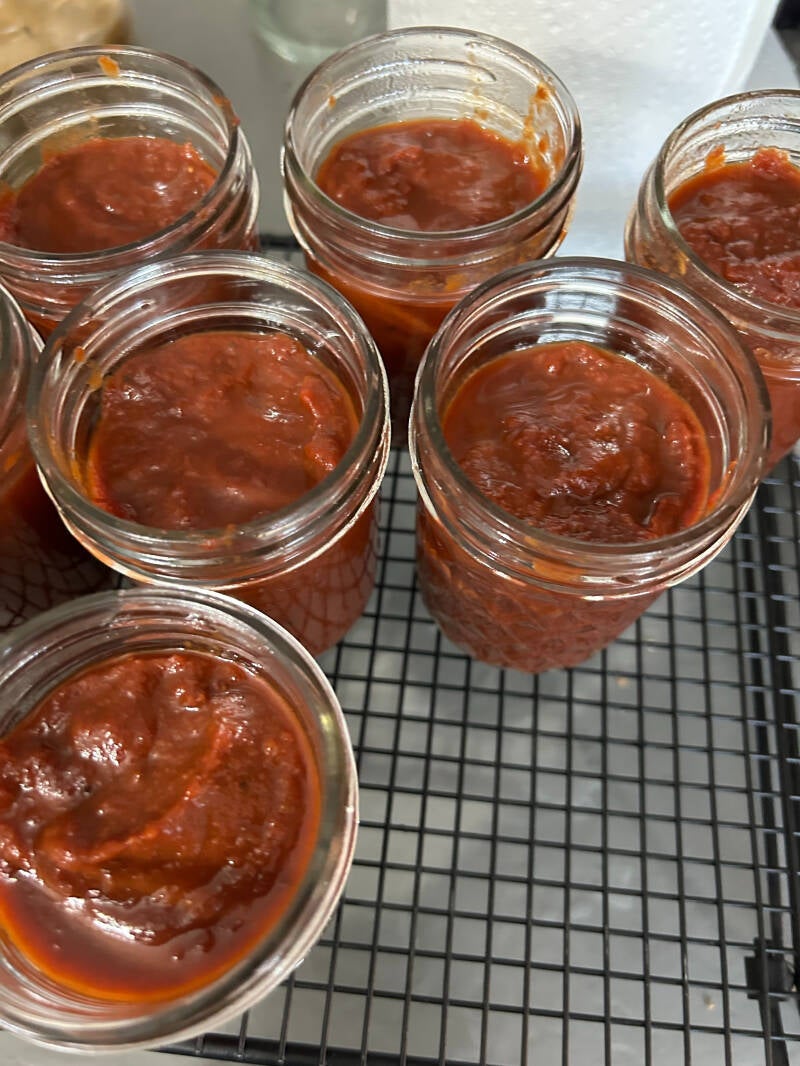
Offenburg Reserve Homemade Ketchup
Our Heinz-Style Homemade Ketchup • Sweet, Tangy & Made From Scratch
Making homemade ketchup is one of those projects that takes a little extra time but is so satisfying when it's finished. There's something pretty great about seeing jars of ketchup made from tomatoes you've grown yourself or purchased when they're fresh and plentiful.
One of my favorite things about making our own ketchup is knowing exactly what goes into it. We can control the ingredients and adjust the seasonings to create the sweet and tangy flavor we like.
We call ours Offenburg Reserve Ketchup. It's our homemade Heinz-style ketchup, and one big batch makes about 22 half-pints—enough to keep us stocked for quite a while!
We use it anywhere we'd normally reach for bottled ketchup: burgers, fries, meatloaf, potatoes, and plenty of other Dinner with Durf recipes.
Important Canning Note: Offenburg Reserve is our personal homemade ketchup recipe. Because this exact formulation has not been laboratory-tested for shelf-stable home canning, I don't provide a water-bath processing time for this recipe. For shelf-stable ketchup, use a research-tested recipe and processing instructions such as those from the National Center for Home Food Preservation. Their tested formulation uses specific ingredient proportions, 5% vinegar, pint jars, 1/8-inch headspace and altitude-adjusted processing times.
NCHFP Tested Tomato Ketchup Recipe & Canning Instructions
🍅 Offenburg Reserve Ketchup Ingredients
Yield: Approximately 22 half-pint jars
- 2 gallons tomato juice
- 4 cups white distilled vinegar
- 3 cups granulated sugar
- 5 tablespoons salt
- 1 tablespoon onion powder
- ½ teaspoon cinnamon
- ½ teaspoon ground cloves
- ½ teaspoon cayenne pepper
- 3 bay leaves
- 2 tablespoons Worcestershire sauce
- 4 (6-ounce) cans tomato paste
A Note About the Vinegar
I use white distilled vinegar in our recipe. When making foods for canning, always check the acidity listed on your vinegar rather than assuming all vinegar has the same acidity. Research-tested NCHFP ketchup recipes specify 5% acidity vinegar.
This post contains affiliate links. As an Amazon Associate I earn from qualifying purchases.
🍅 Step 1: Prepare the Tomatoes
When we're starting with fresh tomatoes, one of my favorite tools during tomato season is our KitchenAid Stand Mixer with the fruit and vegetable strainer attachment.
We process our tomatoes into juice, separating out the skins and seeds. After the first pass, we often run the remaining tomato pulp through again to get as much goodness out of those tomatoes as possible.
Once you have 2 gallons of tomato juice, you're ready to make the ketchup.
🌿 Dinner with Durf Tip
Tomatoes contain a lot of water, so don't worry if your ketchup initially looks much thinner than store-bought ketchup.
The magic happens while it slowly simmers and reduces.
🥫 Step 2: Start the Ketchup
Pour the 2 gallons of tomato juice and 4 cups of white distilled vinegar into a large stock pot.
Bring the mixture to a boil.
Once it reaches a boil, reduce the heat and allow it to simmer uncovered.
⏱️ Step 3: Let It Reduce
Allow the tomato mixture to simmer for approximately 1–3 hours, stirring periodically to keep it from sticking or scorching on the bottom of the pot.
The exact cooking time will depend on your tomatoes, the size of your pot, and how thick you like your ketchup.
I like to give it plenty of time. Homemade ketchup is definitely not a recipe that needs to be rushed!
🌿 Step 4: Add the Offenburg Reserve Seasonings
Once the tomato mixture has reduced, add:
- 3 cups granulated sugar
- 5 tablespoons salt
- 1 tablespoon onion powder
- ½ teaspoon cinnamon
- ½ teaspoon ground cloves
- ½ teaspoon cayenne pepper
- 3 bay leaves
- 2 tablespoons Worcestershire sauce
- 4 (6-ounce) cans tomato paste
Stir everything together thoroughly.
Continue simmering for approximately another hour, stirring frequently, until the ketchup reaches the consistency you like.
How I Check the Consistency
Ketchup thickens as it cools, so don't judge the consistency solely by how it looks while it's bubbling in the pot.
Spoon a small amount onto a dish and let it cool.
Then check the consistency.
If it's still thinner than you'd like, continue simmering the batch and test it again.
❤️ Step 5: Taste & Adjust
Once the ketchup reaches the consistency you like, give it a taste.
This is where you can make small flavor adjustments to a batch you're going to refrigerate or freeze. You might prefer it a little sweeter, saltier, tangier, or spicier.
Remove the bay leaves before storing the ketchup.
If you're following a tested recipe for shelf-stable canning, don't make ingredient changes unless the tested recipe specifically permits them.
🧊 Step 6: Refrigerate or Freeze
Transfer the finished ketchup into clean containers and refrigerate promptly.
For longer storage, portion the ketchup into freezer-safe containers, leaving appropriate room for expansion, and freeze it.
If you want shelf-stable canned ketchup, follow the complete ingredient proportions, jar size, headspace, and processing instructions of a tested canning recipe rather than applying a processing time from another ketchup recipe to Offenburg Reserve.
The NCHFP tested ketchup recipe, for example, is hot-packed into pint jars with 1/8-inch headspace and water-bath processed for 15 minutes at 0–1,000 feet, 20 minutes at 1,001–6,000 feet, or 25 minutes above 6,000 feet. Those times apply to that tested formulation—not automatically to Offenburg Reserve.
🍔 Ways We Use Offenburg Reserve Ketchup
This is one of those pantry staples that finds its way into all kinds of meals.
Of course, it's great with burgers and fries, but we also use homemade ketchup with meatloaf, potatoes, sandwiches and other recipes that need a little sweet-and-tangy tomato flavor.
And because it's homemade, it has become one of those recipes that just feels like part of our kitchen.
💰 Why We Make Our Own Ketchup
For me, making ketchup isn't just about trying to duplicate something from the grocery store.
It's another way to use tomatoes when they're plentiful and turn simple ingredients into something we'll actually use.
Making a large batch also means I know exactly what ingredients went into it—and there's a certain satisfaction that comes from making something as basic as ketchup from scratch.
That's what Dinner with Durf is all about: making good food at home, using what we have, and finding ways to make our grocery dollars stretch a little further.
🛒 My Favorite Tools for Homemade Ketchup
KitchenAid Stand Mixer
Our KitchenAid gets a workout during tomato and canning season.
KitchenAid Fruit & Vegetable Strainer Attachment
This is one of my favorite tools when we're processing large quantities of tomatoes because it helps separate the tomato juice and pulp from the skins and seeds.
Large Stock Pot
You'll want plenty of room for the ketchup to simmer and reduce.
Water Bath Canner
We use a water-bath canner for foods that have a research-tested boiling-water canning process. Always follow a tested recipe's specified ingredients, jar size, headspace, processing time, and altitude adjustment.
As an Amazon Associate I earn from qualifying purchases.
❤️ From Our Kitchen to Yours
Making a big batch of homemade ketchup takes some time, but that's part of what I love about recipes like this.
You take fresh tomatoes and a handful of pantry ingredients and turn them into something completely different.
And every time we pull out our homemade ketchup, I get the satisfaction of knowing we made it ourselves.
That's why this one earned the name Offenburg Reserve.